
Why This Procedure?
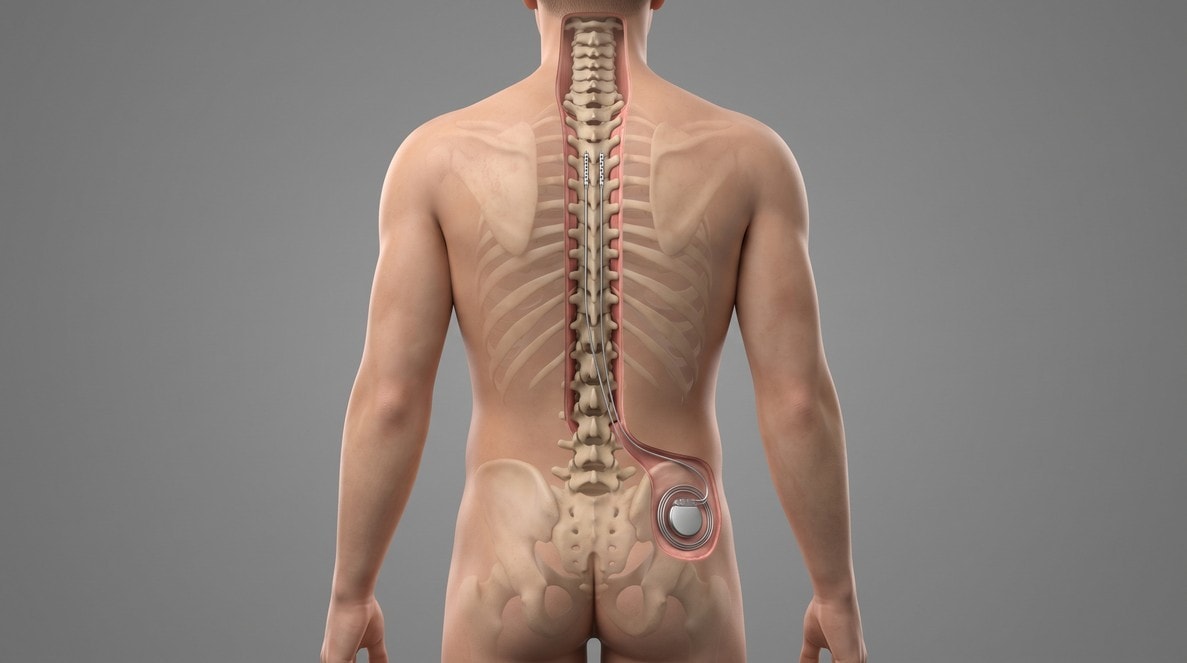
Following a successful trial, a permanent spinal cord stimulator (SCS) system is implanted. This involves placing permanent leads near your spinal cord, connected to a small generator (battery) implanted under the skin, usually in your buttock or flank, which delivers ongoing pulses to interrupt pain signals.
Who Might Benefit?
This procedure may help if you have:
- A prior SCS trial that provided meaningful pain relief and improved function
- Chronic nerve-related pain not adequately controlled by other treatments
How Effective Will It Be, and How Soon?
It isn't possible to guarantee how any individual will respond. As a general guide:
- After implant: the stimulation settings are fine-tuned over the following weeks; benefit is generally expected to be similar to what you experienced during your successful trial, though this can vary.
Risks and Safety
This procedure is generally considered safe when performed under X-ray guidance, though as with any medical procedure benefit cannot be guaranteed and complications rarely occur.
Common, minor effects:
- Soreness at the lead and generator insertion sites for several days to weeks
- Unusual tingling sensation (paraesthesia) from the stimulation
Rare, more serious risks:
- Infection at the lead or generator site, occasionally requiring device removal
- Lead movement (migration) reducing or changing the stimulation effect, sometimes requiring a further procedure
- Generator site discomfort or device malfunction requiring revision
- Bleeding or nerve injury, which may rarely be permanent
- Serious sedation or anaesthetic complications, very rarely including stroke or death
- Reduced effectiveness over time
Before the Procedure
- Tell us about any blood-thinning medication (e.g. warfarin, Xarelto, Plavix) well in advance — special arrangements may be needed and you may be asked to pause these under guidance
- Tell us if you are, or might be, pregnant — this procedure uses X-ray guidance
- Tell us about any allergies, including to contrast dye, local anaesthetics, or reactions to previous injections or anaesthesia
- You will usually be asked to fast for 6 hours beforehand if sedation is planned
- Bring a list of your current medications
- Arrange for someone to drive you home afterwards
What Happens During the Procedure
- The skin over the treatment area is cleaned with antiseptic
- Local anaesthetic numbs the skin before the main needle is placed
- Live X-ray (fluoroscopy) guides the needle precisely to each target
- A brief stimulation test checks the needle is correctly positioned
- Permanent leads are positioned near your spinal cord and connected to a generator implanted under the skin
- The procedure usually takes 60-90 minutes
After the Procedure
- You will be monitored briefly in recovery before going home
- Soreness at the lead and generator insertion sites for several days to weeks is expected — simple pain relief (e.g. paracetamol) usually helps
DO NOT remove or disturb your dressings at any point unless specifically told to by your doctor. This is different from a standard block/RF dressing — disturbing the implant sites risks infection or lead movement. If a dressing becomes loose, wet, or you have any concerns, contact Total Pain Clinic rather than adjusting it yourself.
- Avoid bending, twisting, stretching, lifting, or reaching overhead for several weeks as advised by your doctor
- Avoid driving until cleared by your doctor
- You will be shown how to use your patient controller before discharge
When to Seek Help
Contact your GP, Total Pain Clinic, or your nearest Emergency Department if you notice:
- New or worsening leg weakness, numbness, or difficulty passing urine — this needs immediate Emergency Department assessment
- Increasing redness, swelling, warmth, or discharge at either the lead or generator site
- Fever or feeling generally unwell
- Sudden loss of the stimulation effect, or new weakness or numbness
- The generator site feels like it is eroding through the skin
Follow-Up
You will be seen for wound checks and stimulation programming in the weeks following your implant. Please keep all follow-up appointments so your settings can be optimised.