
Why This Procedure?
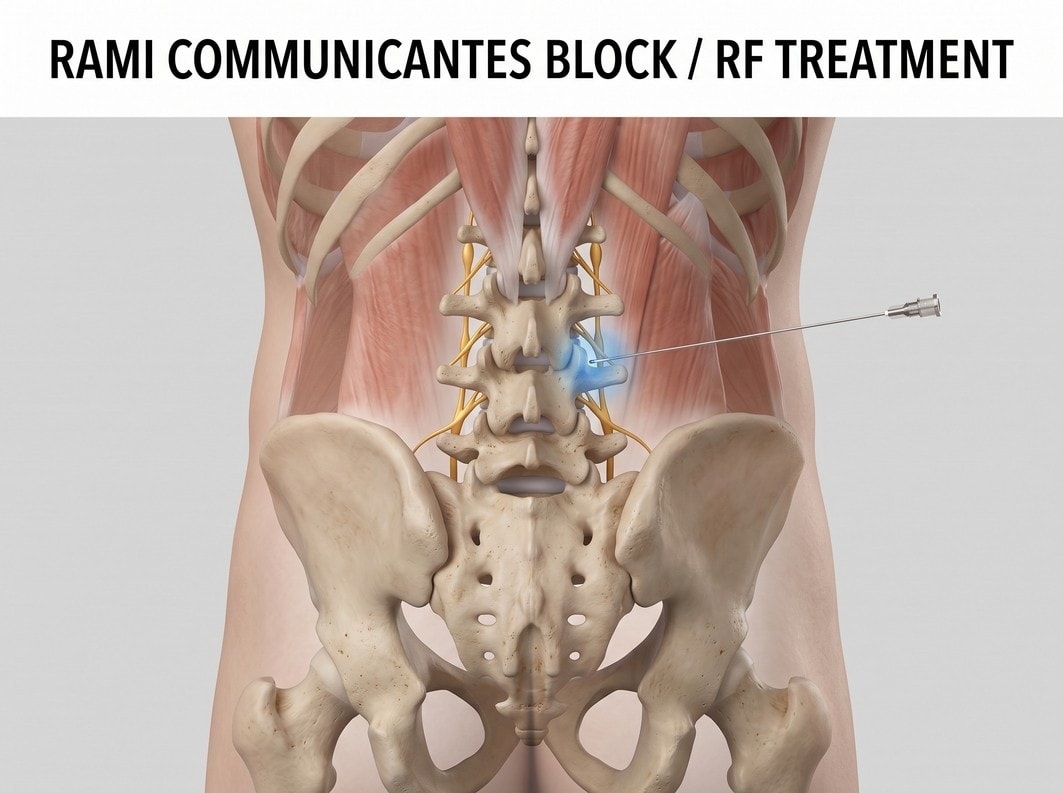
The rami communicantes are small nerve branches that carry pain signals from the disc and front of the spine. When disc-related (discogenic) pain is suspected, targeting these nerves aims to reduce your pain, though individual results vary. There are several treatment options, used only as far as needed:
- Local anaesthetic: numbs the nerve immediately, helping confirm it as a source of your pain.
- Pulsed radiofrequency (pulsed RF): short bursts of energy that calm the nerve without destroying it, aiming for relief lasting weeks to months.
- Thermal radiofrequency (thermal RFA): uses heat to disable the nerve for longer, only considered if pulsed RF relief doesn't last long enough.
Who Might Benefit?
This procedure may help if you have:
- Chronic lower back pain believed to be coming from a disc (discogenic pain)
- Pain not explained by facet joint or sacroiliac joint sources
- Not had lasting relief from physiotherapy, medication, or activity modification
How Effective Will It Be, and How Soon?
It isn't possible to guarantee how any individual will respond. As a general guide:
- Local anaesthetic: works within minutes and wears off after a few hours.
- Pulsed RF: effect usually begins after a couple of weeks and may last for a few months.
- Thermal RFA: full effect typically develops over 6-12 weeks and may last longer, only used if needed.
Risks and Safety
This procedure is generally considered safe when performed under X-ray guidance, though as with any medical procedure benefit cannot be guaranteed and complications rarely occur. Pulsed RF modulates the nerve rather than destroying it.
Common, minor effects:
- Temporary soreness at the injection site
- Brief flare of your usual back pain before it settles
Rare, more serious risks:
- Infection or bleeding at the injection site
- Nerve injury, which may rarely be permanent
- Allergic reaction to the local anaesthetic or contrast dye
- Small increased lifetime risk from the X-ray exposure used to guide the procedure
- Serious sedation or anaesthetic complications, very rarely including stroke or death
- No improvement in pain, or relief that doesn't last
Before the Procedure
- Tell us about any blood-thinning medication (e.g. warfarin, Xarelto, Plavix) well in advance — special arrangements may be needed and you may be asked to pause these under guidance
- Tell us if you are, or might be, pregnant — this procedure uses X-ray guidance
- Tell us about any allergies, including to contrast dye, local anaesthetics, or reactions to previous injections or anaesthesia
- You will usually be asked to fast for 6 hours beforehand if sedation is planned
- Bring a list of your current medications
- Arrange for someone to drive you home afterwards
What Happens During the Procedure
- The skin over the treatment area is cleaned with antiseptic
- Local anaesthetic numbs the skin before the main needle is placed
- Live X-ray (fluoroscopy) guides the needle precisely to each target
- A brief stimulation test checks the needle is correctly positioned
- The procedure usually takes 30-45 minutes
After the Procedure
- You will be monitored briefly in recovery before going home
- Some soreness at the injection sites is common for 1-3 days — simple pain relief (e.g. paracetamol) usually helps
- You may remove the small dressing after 24 hours, keeping the area clean and dry
- Avoid strenuous activity or heavy lifting for 24-48 hours
- If you were sedated, avoid driving, operating machinery, or making important legal or financial decisions for 24 hours
- Continue your regular medications unless specifically advised otherwise
When to Seek Help
Contact your GP, Total Pain Clinic, or your nearest Emergency Department if you notice:
- Increasing redness, swelling, or discharge at the injection site
- Fever or feeling generally unwell
- New weakness, numbness, or loss of bladder/bowel control
- Severe pain not settling with simple pain relief
Follow-Up
A review appointment is usually arranged 2-4 weeks after your procedure to discuss how you responded and plan next steps — please call Total Pain Clinic reception to schedule this if it hasn't already been arranged. Please ask your doctor any questions before you proceed; you will be asked to sign a consent form if you agree to go ahead.