
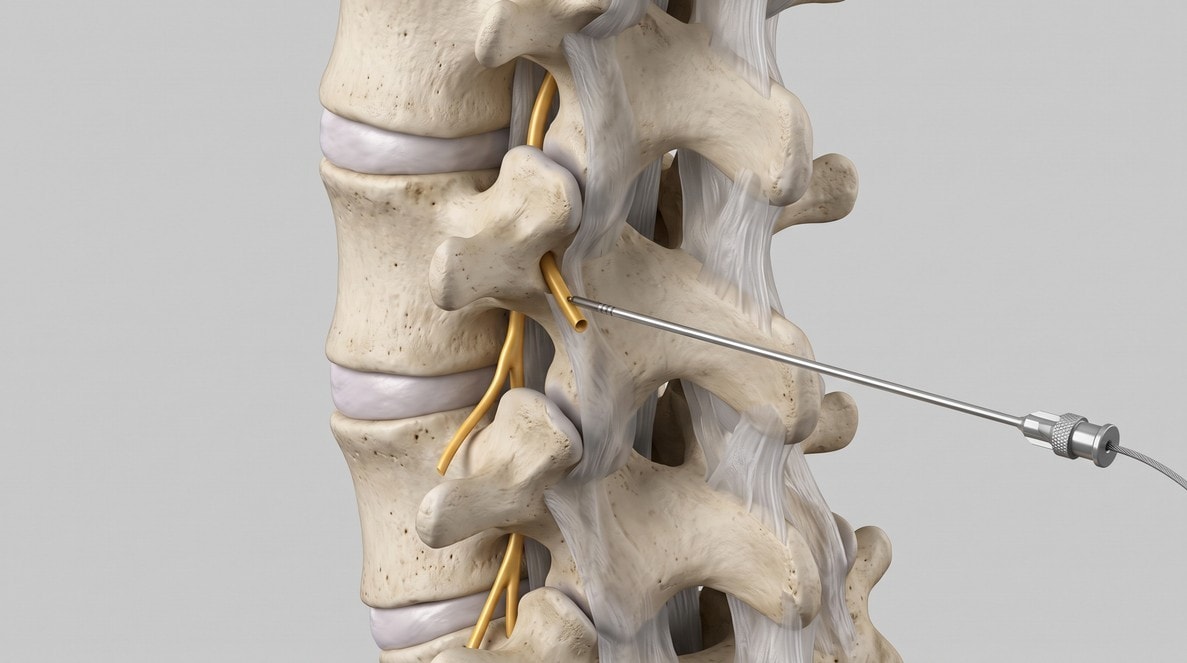
Why This Procedure?
The small facet joints that run down each side of your lumbar spine are supplied by tiny nerves called medial branches. When these joints become a source of pain — often from wear and tear (osteoarthritis) — targeting these nerves aims to reduce your pain, though individual results vary. There are several treatment options, used only as far as needed:
- Local anaesthetic: numbs the nerve immediately, confirming these nerves are a source of your pain.
- Steroid: reduces inflammation around the nerve for longer-lasting relief.
- Pulsed radiofrequency (pulsed RF): short bursts of energy that calm the nerve without destroying it, aiming for relief lasting weeks to months.
- Thermal radiofrequency (thermal RFA): uses heat to disable the nerve for longer (typically 6-18 months), only considered if pulsed RF relief doesn't last long enough.
Some practitioners consider combining the local anaesthetic, steroid, and pulsed RF when there is a strong clinical indication that the facet joints are the main source of pain, as it can reduce the number of procedures needed and the sedation and radiation exposure that comes with repeating them. Thermal RFA is only used as a further option if needed — in many cases it isn't required at all.
Who Might Benefit?
This procedure may help if you have:
- Chronic lumbar pain that doesn't travel down the arm/leg (non-radicular)
- Pain that worsens with certain movements or prolonged posture
- Imaging or examination findings suggesting facet joint arthritis
- Not had lasting relief from physiotherapy, medication, or activity modification
How Effective Will It Be, and How Soon?
It isn't possible to guarantee how any individual will respond. As a general guide:
- Local anaesthetic: works within minutes and wears off after a few hours.
- Steroid: starts working after a few days and the effect can last for weeks or sometimes longer.
- Pulsed RF: effect usually begins after a couple of weeks, continues to improve over the first month or two, and may last for a few months.
- Thermal RFA: initial benefit may be noticeable once post-procedure soreness settles after a few days, with the full effect typically developing over 6-12 weeks and often lasting several months to over a year.
Risks and Safety
This procedure is generally considered safe when performed under X-ray guidance, though as with any medical procedure benefit cannot be guaranteed and complications rarely occur. Pulsed RF modulates the nerve rather than destroying it, so it does not carry the numbness or heaviness risk sometimes seen with thermal RFA.
Common, minor effects:
- Temporary soreness or bruising at the injection site for a day or two
- Brief flare of your usual pain before it settles
- Temporary rise in blood sugar for 1-2 days after the steroid, particularly if you have diabetes
Rare, more serious risks:
- Infection or bleeding at the injection site
- Nerve injury, which may rarely be permanent
- Allergic reaction to the local anaesthetic, steroid, or contrast dye
- Small increased lifetime risk from the X-ray (fluoroscopy) exposure used to guide the procedure
- Serious sedation or anaesthetic complications, very rarely including stroke or death
- No improvement in pain, or relief that doesn't last (failure to confirm the source, or the effect wearing off sooner than hoped)
Before the Procedure
- Tell us about any blood-thinning medication (e.g. warfarin, Xarelto, Plavix) well in advance — special arrangements may be needed and you may be asked to pause these under guidance
- Tell us if you are, or might be, pregnant — this procedure uses X-ray guidance
- Tell us about any allergies, including to contrast dye, local anaesthetics, or reactions to previous injections or anaesthesia
- You will usually be asked to fast for 6 hours beforehand if sedation is planned
- Bring a list of your current medications
- Arrange for someone to drive you home afterwards
What Happens During the Procedure
- The skin over the treatment area is cleaned with antiseptic
- Local anaesthetic numbs the skin before the main needle is placed
- Live X-ray (fluoroscopy) guides the needle precisely to each target
- A brief stimulation test checks the needle is correctly positioned
- Local anaesthetic, steroid, and pulsed RF are given through the same needle placement
- The procedure usually takes 20-40 minutes depending on how many levels are treated
After the Procedure
- You will be monitored briefly in recovery before going home
- Some soreness at the injection sites is common for 1-3 days — simple pain relief (e.g. paracetamol) usually helps
- You may remove the small dressing after 24 hours, keeping the area clean and dry
- Avoid strenuous activity or heavy lifting for 24-48 hours
- If you were sedated, avoid driving, operating machinery, or making important legal or financial decisions for 24 hours
- Continue your regular medications unless specifically advised otherwise
When to Seek Help
Contact your GP, Total Pain Clinic, or your nearest Emergency Department if you notice:
- Increasing redness, swelling, or discharge at the injection site
- Fever or feeling generally unwell
- New weakness, numbness, or loss of bladder/bowel control
- Severe pain not settling with simple pain relief
Follow-Up
A review appointment is usually arranged 2-4 weeks after your procedure to discuss how you responded and plan next steps — please call Total Pain Clinic reception to schedule this if it hasn't already been arranged. Please ask your doctor any questions before you proceed; you will be asked to sign a consent form if you agree to go ahead.